
Recently, I’ve found myself returning to a question:
When a tool becomes more capable, what exactly changes?
The most immediate answer seems to be that we can do more. Computers keep getting faster at calculations, software can handle increasingly complex tasks, and artificial intelligence is gradually acquiring capabilities that were once difficult to achieve. Work that used to take a great deal of time—or even require specialized training—can now sometimes produce a result in a matter of moments.
Following this line of thought, technological progress should make problems increasingly easy to solve. But a closer look reveals that things are not quite so simple. Some tasks really do become easier as tools improve. Others do not disappear; the difficulty simply shifts from one place to another. In some cases, it is only when we can finally do something with ease that we begin to realize the thing itself was never the real problem we needed to solve.
This leaves me with a question: When we talk about growing capabilities, are we talking only about greater efficiency in solving problems, or does this growth also change how we understand the problems themselves?
When Something Becomes Easier#
Let’s start with calculation.
Before calculators became widespread, complex calculations demanded considerable time and effort. People had to plan the steps, avoid mistakes, and consider whether a calculation was worth the cost of carrying it out. Once calculators made many tedious operations easy, people could try more things and devote more effort to building models, comparing options, and interpreting results.
A calculator does not decide what we should calculate. But it changes how cheaply we can calculate, and which things become worth trying.
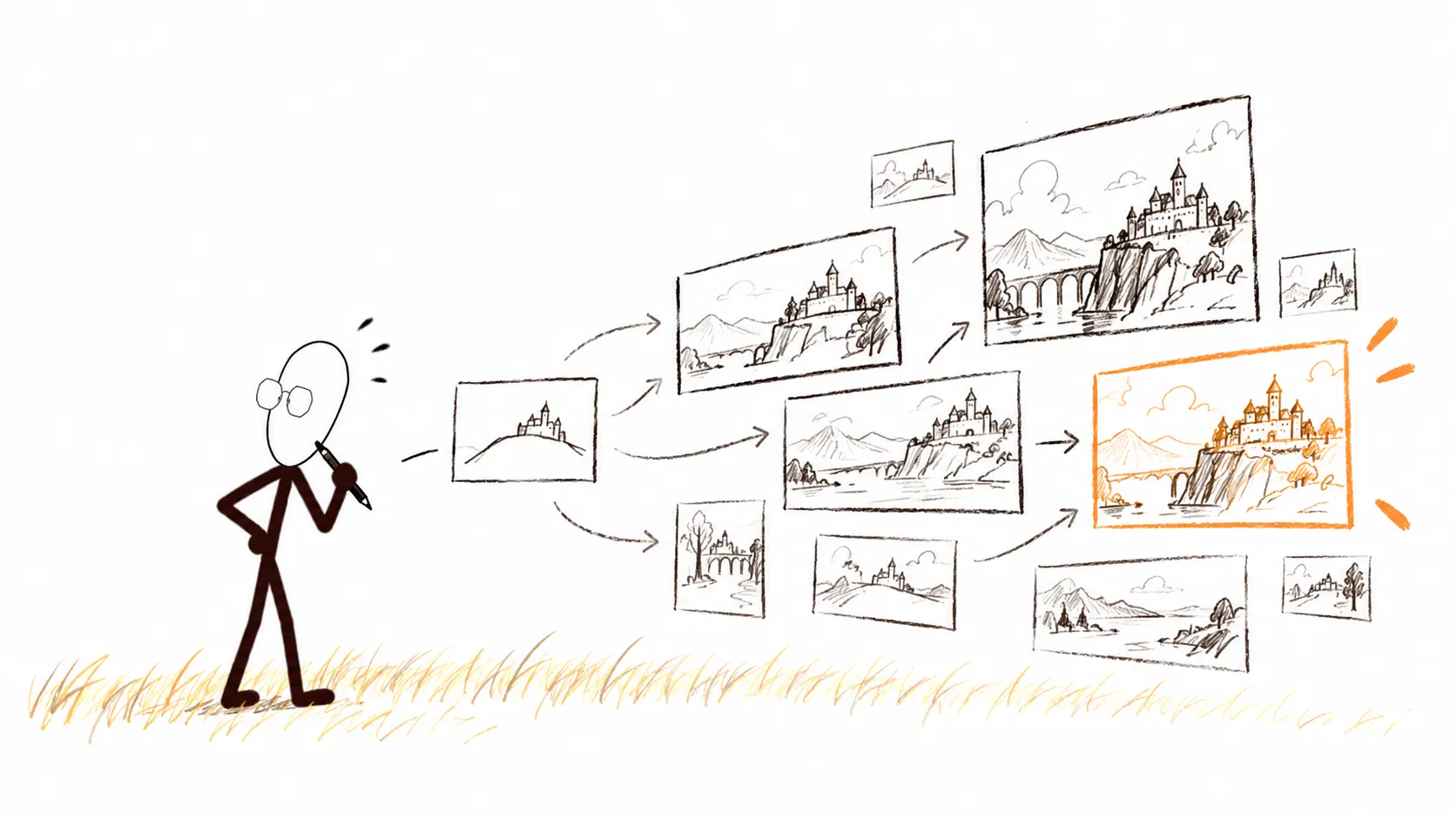
A similar change can happen in creative work. Imagine an artist working on a complex illustration containing several characters, a richly layered background, and a great deal of detail. If every revision is cumbersome, the artist has to think carefully before drawing and try to avoid rework. When drawing tools make layer management and local edits easier, the artist can experiment with different compositions, adjust the positions of characters, or even abandon the original plan.
Possibilities that were once ruled out because they were too costly now become part of the artist’s range of choices.
But as opportunities to experiment increase, new questions may arise: When several options all seem viable, which one should we choose? If a revision makes an image more polished, has it actually made the work better? If details can be adjusted indefinitely, when should we stop?
The change here is not that tools necessarily make creative work more difficult. Rather, when drawing and revision are no longer the main constraints, creators have an opportunity to address questions they previously had little time to consider.
Of course, when a task has a clearly defined goal, better tools really can make it faster to complete. But in fields where goals can keep expanding, lower costs may also encourage people to pursue goals that were previously too expensive to attempt.
Greater capability can lower the cost of solving existing problems, but it can also lead us to confront problems we were previously unable to tackle.
Why Do We Usually Understand Problems in Terms of Capability?#
When we encounter a difficulty, we tend to ask what capability we lack. If our calculations are not accurate enough, we look for a better calculator. If our drawing process is too slow, we learn new techniques or use more suitable software. This is a natural response, because many difficulties really do stem from insufficient capability.
But capability also influences how we perceive a problem.
Return to the illustration. If the artist’s tool lacks flexible layer-management features, they may spend much of their effort planning the drawing order and minimizing rework. Their main concern is naturally how to finish the image without running into trouble. Once the tool is no longer an obvious limitation, they have more room to think about the visual center of the composition, the relationships between characters, and what viewers should notice first.
We usually understand problems within the range permitted by our existing capabilities. Things that are too costly to attempt, or impossible to achieve with our current methods, rarely become the focus of our thinking. As a result, growing capability can mean not only that we do more, but also that problems previously outside our field of vision gradually become visible.
There is, however, an important distinction to keep in mind:
Growing capability does not necessarily mean that we are closer to the result we actually want.
Suppose an artist keeps learning new techniques and mastering more drawing features, yet still feels that their work lacks appeal. The problem may not be that their drawing skills are inadequate. What needs closer examination might be the clarity of the composition, whether the image has a clear visual focus, or what the work is trying to express.
If we interpret every difficulty as a lack of capability, we may keep looking for more powerful tools and accumulating more techniques without reconsidering how the problem has been defined.
A question that began as “How can I do this better?” gradually becomes another question: What kind of result do I actually want?
Does the Value of a Feature Change Too?#
This brings me back to products.
When a feature is difficult to implement, a product that can provide it naturally has an advantage. Users need a certain capability, and only a small number of products can meet that need. The feature itself then becomes an important source of differentiation.
But when technological progress makes that capability easier to obtain, the situation may change. Tasks that only a few products could once handle can now be completed by many. The feature remains useful; it simply no longer distinguishes products as easily as it once did.
Imagine two drawing tools on the market. Both offer basic features such as layer management, selection editing, undo, and a variety of brushes, and their drawing capabilities are quite similar. One offers a wealth of options but requires users to move frequently between complicated menus and operations. The other may not have more features, yet allows artists to draw and revise their work smoothly.
For someone who only wants to finish a simple illustration, the difference between the two tools may be small. For an artist who regularly creates complex work, however, the continuity of the workflow, the ease of making revisions, and the tool’s fit with their way of working may become important factors in choosing one over the other.
This does not mean that experience will inevitably replace functionality. Accuracy, stability, and performance can still be decisive, and a pleasant experience cannot compensate for missing essential features. What matters is this: once basic capabilities are sufficient to meet a need, what else might be preventing users from achieving their goals?
From this perspective, product differentiation does not simply shift from functionality to experience. Rather, the criteria for evaluating a product may change as the problem changes. At first, users may care most about whether a task can be completed, making functionality crucial. When completing the task is no longer difficult, the value of carrying out the whole process more naturally and reliably may become more apparent.
There is therefore no simple proportional relationship between stronger functionality and greater product value. What a feature enables a product to do and how much value it delivers in a particular context are related, but they are not the same question.
If We Change the Problem, Do the Relationships Between Capabilities Change Too?#
If we change not only the criteria for evaluation but also the goal we are pursuing, the relationships between different capabilities may change as well.
Consider the illustration again. If the artist’s goal is simply to finish the image as quickly as possible, drawing speed and the cost of revision may be the most important measures. But if the artist wants the illustration to help viewers understand a complex concept, visual polish is no longer the only standard. They must also consider how information is arranged, which elements should stand out, and whether viewers can understand the relationships between them.
Drawing ability still matters, but it is no longer enough to determine the final result. It turns an idea into an image, while composition and information design help the image serve its communicative purpose. These are no longer independent abilities; they need to work together around a new goal.
This makes me think about the relationship between artificial intelligence and human capabilities.
If we focus only on whether a task can be completed quickly, the degree of automation, execution speed, and cost may be the most useful measures for comparison. But if we care about the entire process, from beginning to end, we also need to consider how goals are set, how results are judged, and how different stages connect. In that case, what machines can do, where people should be involved, and how the two can work together cannot be decided solely by comparing the strength of one particular capability.
Of course, this does not mean that humans will always be better at judgment or that machines can only execute instructions. As technology develops, these boundaries will change too. What we need to pay attention to is whether our criteria for evaluation still fit the problem at hand.
This also offers a way to understand disagreements. When two people debate whether a tool is good, one may focus on how quickly it completes a particular task, while the other cares about how well it fits into a long-term workflow. Neither is necessarily wrong; they are simply using different criteria. Without first clarifying the problem each person is trying to solve, continuing to compare the tools may not bring the discussion any closer to an answer.
Capabilities that once seemed to compete may sometimes become complementary when the goal is reframed. The point is not to force them to work together, but to understand which parts of a problem each is suited to address, and how those parts can serve the larger goal.
Which Changes the Other: Problems or Capabilities?#
At this point, I began to wonder whether capabilities and problems have a fixed order of precedence.
At first, we seek new capabilities because we encounter difficulties. When a new tool appears, some of the old constraints ease, giving us a chance to pursue new goals. As those goals change, the existing tools may reveal new shortcomings, prompting us to look for new methods.
For the artist, improvements in layer management and local editing may make it possible to explore more complex compositions. Once composition is no longer difficult to achieve, the organization of visual information and the arrangement of narrative emphasis may become more important. The next step may not be to find a tool with more brushes, but to adjust the workflow or learn new ways of visual expression.
New problems can drive further improvements in tools, or lead people to reorganize the capabilities they already have. Conversely, the arrival of new tools can change how people understand problems, bringing previously impractical goals into view.
The two seem to shape each other through practice. We choose what to attempt based on our existing capabilities, and the results of those attempts change how we understand the difficulties we face.
If this observation holds, the effects of technological progress may go beyond enabling us to complete more tasks. It may also gradually change which tasks we consider worth completing. But this is not inevitable. Some improvements simply make existing work faster and cheaper without creating new goals. Some new problems require no technological breakthrough at all, only a better method.
So when stronger capabilities fail to produce the improvement we expected, it may help to distinguish among several possibilities: Are our capabilities still insufficient? Is our current method unsuitable? Or does our understanding of the problem need to change? These possibilities may look similar, but they point toward different solutions.
Do We Need Greater Capability, or Better Questions?#
I do not think we have to choose between the two. Without the necessary capabilities, many ideas can remain mere possibilities. But if we focus only on improving our capabilities, we may keep optimizing something that does not matter.
If the artist’s drawing skills are genuinely insufficient, continued practice makes sense. If the tool limits their ability to revise the image, switching to a more suitable tool may solve the problem. But if their skills are already adequate and the real difficulty is that the image lacks a clear communicative focus, learning more advanced drawing techniques may not be the most effective approach.
This also leads me to reconsider the question I began with. When a tool becomes more capable, we can certainly observe how much easier it makes existing tasks. But perhaps we should also ask: once the old constraints disappear, what begins to shape the result? Have we started pursuing new goals? Are the capabilities we once considered important still the key factors determining the outcome?
Of course, redefining a problem more often is not always better. Some tasks already have sufficiently clear goals, and continually changing the criteria can undermine our ability to act. A shift in the way we frame a problem does not guarantee a better result; it still has to stand up to reality.
For now, I am inclined to treat this as a possibility worth keeping in mind:
When greater capability fails to bring the improvement we expected, instead of simply looking for a more powerful tool, we can pause and ask whether our understanding of the problem needs to change.
I still do not have a definite answer to where people will turn their attention once a capability becomes widespread, or which things they will then come to consider worth pursuing.
But perhaps the most interesting thing to observe about technological progress is not just what it enables us to do. It is which constraints it changes—and which problems, once outside our field of vision, finally become questions we can seriously think about.