
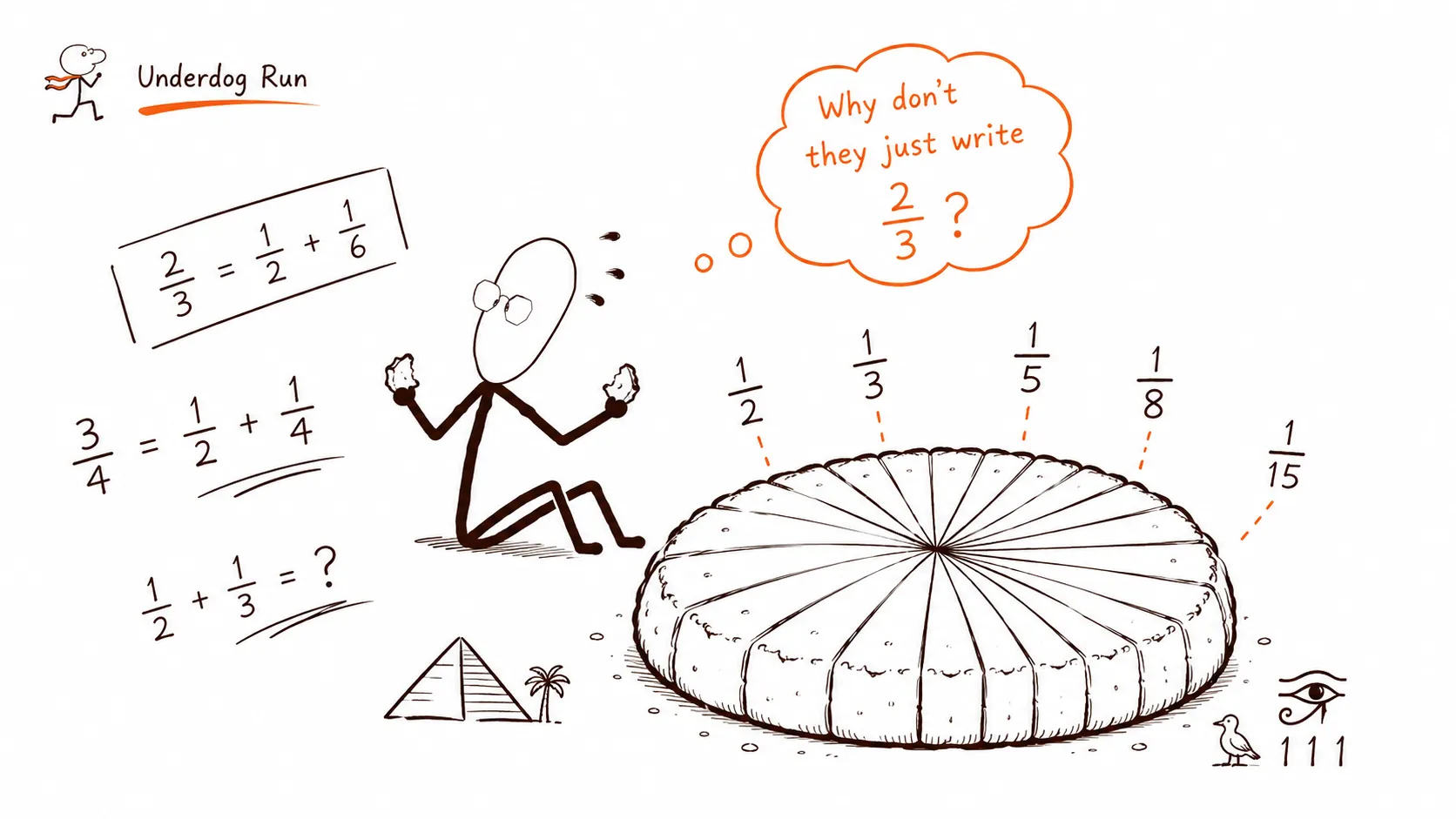
Today, few of us ever stop to think about how fractions should be written.
Whether it is 3/4 in an elementary school textbook or 17/23 in an engineering calculation, we instinctively use the familiar numerator-over-denominator notation. It has become such a natural part of modern mathematics that we rarely question it. In fact, most of us assume that fractions have always been written this way.
History tells a very different story.
In the early development of human civilization, different cultures invented remarkably different systems for representing fractions. Among them, the approach adopted by ancient Egypt is perhaps the most surprising.
Instead of writing ordinary fractions such as 2/3, 3/5, or 7/11, Egyptian mathematicians insisted that almost every fraction should be expressed as the sum of several unit fractions.
A unit fraction is simply a fraction whose numerator is always 1. For example:
To the ancient Egyptians, these were not exceptional cases. They were the fundamental building blocks of every fraction.
For example, today we would simply write
An Egyptian scribe would instead write
Likewise,
would become
This way of decomposing fractions appears throughout Egyptian mathematics.
The first reaction of most modern readers is usually the same:
Why make such a simple fraction so complicated?
The question itself, however, reflects a modern mathematical perspective.
To the Egyptians, unit fractions were the natural language of mathematics. It is our familiar fraction notation that is the historical newcomer.
Why Did Unit Fractions Become the Foundation of Egyptian Mathematics?#
There is no single explanation accepted by all historians of mathematics. Nevertheless, the historical context offers several convincing clues.
Ancient Egypt was a civilization built upon agriculture, taxation, large-scale construction, and the management of resources. Measuring fields, distributing grain, paying workers, and organizing state projects all required the frequent division of a whole into smaller parts.
Within this context, “one part of a whole” became the most intuitive quantitative concept.
Imagine a loaf of bread divided equally into five pieces.
Each piece is
If two pieces are given away, one may naturally think of them as
Over centuries, this way of thinking gradually evolved into an entire mathematical language built upon unit fractions.
There is, however, an important detail that is often overlooked.
Egyptian mathematicians generally did not allow the same unit fraction to appear twice in a decomposition.
Consequently, an expression such as
would not normally be considered an acceptable final answer. Instead, it would be rewritten as a sum of different unit fractions. For example,
This reveals something important about Egyptian mathematics.
Their goal was not merely to obtain the correct numerical result. They also sought to express numbers according to a well-defined mathematical convention.
In other words, unit fractions were not simply a computational technique—they formed an entire mathematical language.
The Fraction Table in the Rhind Mathematical Papyrus#
Perhaps the clearest illustration of this mathematical language can be found in the Rhind Mathematical Papyrus, one of the most important surviving mathematical texts from ancient Egypt, dating to around 1550 BCE.
Surprisingly, the papyrus does not begin with arithmetic exercises.
Instead, it opens with an extensive table of fraction decompositions.
For example:
- How should be written?
- How should be written?
- How should be written?
Rather than expecting the reader to discover these decompositions independently, the papyrus provides standard forms in advance.
To modern readers, this may seem rather strange.
Why would a mathematics book devote so much space simply to teaching people how to write fractions?
The answer is that this was not merely a computational trick.
It was the grammar of Egyptian mathematics.
Just as learning a spoken language begins with mastering its alphabet and vocabulary, learning Egyptian mathematics began with mastering its system of unit fractions.
Only after everyone shared the same mathematical language could more sophisticated calculations be carried out consistently.
Mathematics Has Never Had a Single Language#
Perhaps the most important lesson that unit fractions teach us is not that they were more efficient—or less efficient—than modern fractions.
Their real significance lies elsewhere.
They remind us that mathematical notation is not a law of nature.
The fractions, symbols, and conventions we use today are the products of thousands of years of historical evolution.
Different civilizations developed different mathematical languages.
- The Babylonians built their mathematics upon a base-60 numeral system.
- The Romans relied on Roman numerals.
- Ancient China developed sophisticated calculation methods using counting rods.
- Ancient Egypt constructed an entire fractional language based on unit fractions.
Each civilization was attempting to answer the same fundamental question:
How can quantities be represented as clearly and accurately as possible?
The answers, however, were remarkably different.
From Unit Fractions to the Equal Sign#
Understanding unit fractions also sheds light on a much larger historical question.
If even fractions were written in a completely different way in ancient Egypt, how did Egyptian mathematicians express something as fundamental as equality?
The answer is that they largely could not—not in the symbolic sense we understand today.
They possessed neither modern fraction notation nor the equals sign.
They were capable of remarkably sophisticated calculations, yet they lacked a concise and abstract way to express mathematical relationships.
This is precisely why, thousands of years later, a seemingly simple symbol—the equals sign—would become one of the most revolutionary inventions in the history of mathematics.
Its importance lay not merely in changing the way mathematics was written.
It transformed the way mathematical relationships themselves could be expressed.
Why Did Unit Fractions Eventually Disappear?#
If unit fractions served Egyptian mathematics for more than two thousand years, another natural question arises:
Why are they no longer used today?
The answer is not that Egyptian mathematics was “wrong.”
Rather, as mathematics continued to evolve, unit fractions gradually became insufficient for increasingly sophisticated forms of reasoning.
For ancient Egypt, mathematics was primarily a practical discipline.
Its principal tasks included measuring land, distributing grain, organizing construction projects, and collecting taxes.
For these purposes, unit fractions were perfectly adequate, even if they required lengthy notation.
Over time, however, mathematics began to move beyond practical computation.
It gradually developed into a discipline concerned with patterns, structures, and relationships.
As this transformation took place, the limitations of unit fractions became increasingly apparent.
Consider the expression
In modern notation, the calculation is straightforward.
Within the Egyptian system, however, each ordinary fraction would first have to be decomposed into several unit fractions before any calculation could even begin.
The notation became longer.
The calculations became more complicated.
And the possibility of error increased accordingly.
More importantly, unit fractions obscure structural relationships between numbers.
Consider the following sequence:
To a modern mathematician, these fractions clearly share the same denominator and therefore belong to a common numerical family.
Within the Egyptian system, however, this relationship largely disappears.
For example,
while
The common denominator is no longer visible.
The structural connection between the two quantities becomes much harder to recognize.
As algebra gradually emerged, this loss of structure became a serious obstacle.
The History of Mathematics Is Also the History of Mathematical Language#
The advancement of mathematics has never depended solely upon new discoveries or more powerful methods of calculation.
It has also depended upon better ways of expressing ideas.
Unit fractions gave humanity one of its earliest systematic languages for representing fractions.
Indian mathematicians gradually developed the compact fraction notation that remains in use today.
Arabic scholars preserved, refined, and transmitted these ideas throughout the medieval world.
Over the centuries, new mathematical symbols continued to appear:
negative numbers, decimal notation, the equals sign, algebraic variables, function notation, coordinate systems, and many others.
Each new notation expanded the kinds of ideas that mathematicians were able to think about.
From this perspective, the history of mathematics is not merely the history of calculation.
It is also the history of an evolving language.
Unit fractions did not fail.
They simply fulfilled the role they were capable of fulfilling.
As mathematics demanded a language that was more compact, more systematic, and better suited to abstraction, a new notation gradually replaced the old.
Today, when we casually write
few of us realize that this ordinary-looking symbol represents the endpoint of thousands of years of experimentation in mathematical expression.
That is one of the most fascinating aspects of mathematical civilization.
Its greatest achievements are not only new methods of calculation, but new ways of expressing ideas—and ultimately, new ways of thinking about the world.